Submitted by Eric Daniel
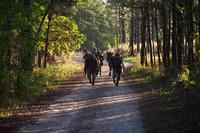
Had an interesting experience the other day. My Guard unit went out for a three day jaunt into the wilds of Camp Pendleton to conduct some dismounted reconnaissance training. Now, granted, we were technically "on base" but since we're a leg unit, we have to support ourselves; no barracks, no latrines, no water sources, etc. We were responsible for everything.
With this in mind, when I started to pack my kit, I had to pause for a minute to think about what I was going to do for some form of shelter. That's when it dawned on me that the Army really hasn't advanced past the WWII era canvas shelter half when it comes to individual shelters. Yes, they have great and wonderful expanding and self-erecting medium sized tents, which weigh 300 pounds and fit nicely in the back of a 1.25-ton trailer, but there's nothing for the individual.
Now I've heard all the arguments about this before, "you can't use a tent in combat" and "you just need to use what's available to you in the field, namely, use brush and trees or dig out a shelter" being the most often cited ones, but we're not talking combat here, we're talking bivouacking in the field. Moreover, on most bases where you conduct training, chopping up the flora or digging in the ground is strictly verboten, so those really aren't options. The bottom line is, if you're going to be out in the field for longer than a couple of days in really crappy weather, it'd be nice, tactical situation permitting of course, to have the ability to get out of the rain. Those gortex bivy sacks we're issued now are nice for snow or a light drizzle, but in an out and out downpour you really can't get into it fast enough to prevent the sleeping bag from filling with water, and that's assuming that you jump in with all your wet clothes on. In those situations, you're probably better off just putting on your wet weather gear and trying to sleep through it.
So, I started doing a little research. There are a number of companies out there that make good, ultra light, 1-man tents. Unfortunately, most of those are alpine supply companies like MSR, The North Face, and Mountain Hardware and their products tend to be a bit, well, colorful (now this is not to say that these folk wouldn't make one of their tents in a different color fabric as a custom order job, but that's probably not a realistic option for the Joe looking to purchase one tent) and have a lot of parts. In fact, the only company I found that made an honest-to-God military style tent was Eureka, who makes both 1-man and 2-man systems, with a reversible woodland/desert camouflage pattern rain fly to boot (as an added bonus you can opt to just use the rain fly as a stand alone shelter if you don't need the additional wind protection.) The only downside to the Eureka tent is weight; the one man tent, complete, weighs just over 6 pounds, though it is certainly something you could spent your entire military career sleeping out of.
Another interesting option, and certainly one of significant weight savings, was to go the engineered tarp route. The folks over at Tarptent make some awesome, lightweight (18-oz. in the case of their 1-man shelter) shelters that are easy to set up, roomy, and keep the rain off of you, and the color is even reasonably tactical. In addition, they also provide, free of charge and publically available on their website, the plans to build your own first generation tarptent out of what ever material you choose.
So my solution? I snapped a couple of ponchos together, brought some bungees, 550 cord, and a handful of lightweight aluminum tent pins and lashed a lean-to to a tree limb and slept like a brick through two straight nights of continuous rain. Granted it got the job done but I was completely dependent upon that tree being there for me to tie off on. In the future I might have to look seriously into either some shock tubes I can erect to create a free standing dome for my ponchos one of those tarptents.